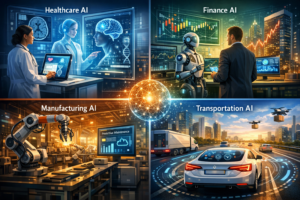
Healthcare
AI is already revolutionizing healthcare by improving diagnostic accuracy, enhancing patient care, and streamlining administrative tasks. Machine learning algorithms can analyze medical images (like X-rays and MRIs) more quickly and accurately than human doctors, helping to detect conditions such as cancer, heart disease, and neurological disorders in their early stages. In the future, AI has the potential to further personalize healthcare. AI-powered tools could analyze your medical history, lifestyle, and genetic information to create customized health plans and predict health risks. Virtual healthcare assistants could become more common, offering real-time advice, medication reminders, and even monitoring chronic conditions.
Finance
AI is already making waves in the finance sector, improving efficiency and accuracy in areas such as fraud detection, customer service, and investment strategies. Banks and financial institutions are using AI to analyze transactions and identify potential fraud patterns. Robo-advisors—AIpowered tools that offer investment advice based on data analysis—are also growing in popularity. Looking ahead, AI could further revolutionize the financial world by predicting market trends, optimizing investment portfolios, and even providing personalized financial planning for individuals. This would make financial advice more accessible and help investors make more informed decisions.
Manufacturing
In manufacturing, AI is enhancing production efficiency and reducing costs through predictive maintenance, automation, and quality control. Machines equipped with AI algorithms can predict when parts need to be replaced before they break, minimizing downtime and improving production efficiency. The future of AI in manufacturing is set to include more autonomous factories where machines perform the bulk of the work, with minimal human intervention. These smart factories will be able to optimize production in real-time based on changing conditions, improving the speed and f lexibility of manufacturing processes.
Transportation
Self-driving cars are perhaps one of the most high-profile applications of AI. Autonomous vehicles rely on AI to navigate, avoid obstacles, and make decisions in real time. While we’re still in the early stages of self-driving technology, the potential impact is enormous. By reducing human error, AI could make transportation safer, more efficient, and even reduce traffic congestion.
Beyond autonomous vehicles, AI is also being used in logistics and supply chain management to optimize delivery routes, predict demand, and ensure timely shipments. In the future, AIpowered transportation systems could transform everything from city infrastructure to the way goods and people move around the world.